Back
Commercial Work Trucks: 7 Strategies for the Road Ahead in 2026 December 22, 2025
How to Make Strong, Low-Risk Decisions in a Slowly Evolving Commercial Work Truck Market
As January 2026 begins, commercial work-truck operators—whether in construction, service trades, last-mile delivery, vocational work, or regional trucking—are facing a very different environment than just a couple of years ago.
The market appears to have cooled, with freight demand being uneven, interest rates remaining elevated, input costs being unpredictable, and many OEMs scaling back production after soft orders in 2025. Meanwhile, the used-truck supply is tighter than many expected, and regulatory and emissions pressures are inching closer to the forefront.
For business owners, this combination creates risk, but also opportunity for operators who make strategic, disciplined choices.
Below are the 7 most important fleet-management strategies to prioritize at the start of 2026:
1. Prioritize Your Work Truck Fleet Reliability Over Fleet Expansion
If the last few years were about growth and securing trucks at any cost, 2026 is the opposite.
A soft freight and work-volume environment means many operators are shifting focus from growth to operational efficiency, lifespan extension, and selective replacements.
This year’s winning formula is:
- Replace only the vehicles that are truly at the end of their life
- Improve uptime through stronger maintenance or extending warranties/service plans
- Sweat your assets—but not to the point of catastrophic failure
- Make targeted work truck part upgrades that save fuel or reduce downtime
When work volume is unpredictable, reliable work trucks are more valuable than more trucks.
2. Re-Evaluate Whether New or Used Work Trucks Make the Most Financial Sense
With new work truck inventories thinner and prices sticky, and used work truck supply not as plentiful as predicted, owners should take a more analytical approach to each acquisition.
Ask yourself:
- How many years of service do I realistically need out of this work truck?
- How quickly does this type of work truck generate a return on investment?
- Does my business benefit more from lower upfront cost (used work truck), or lower repair burden (new work truck)?
In a slower market, total cost of ownership matters far more than sticker price. Many operators in 2026 will find that late-model used trucks—2–4 years old—hit the sweet spot of cost, capability, and reliability.
3. Revisit Financing Strategies and Cash-Flow Planning
Elevated interest rates across 2025–2026 mean financing a work truck looks very different than it did just a couple of years ago.
Business owners should:
- Consider shorter financing terms for better rate positioning
- Explore refinancing options on older loans that originated during peak rates
- Keep cash reserves higher to weather fluctuations in freight or job volume
- Evaluate leasing options if you need flexibility or lower upfront capital outlay
In January 2026, liquidity and flexibility are strategic advantages.
4. Shift Toward Right-Sizing and Versatile Vehicle Choices
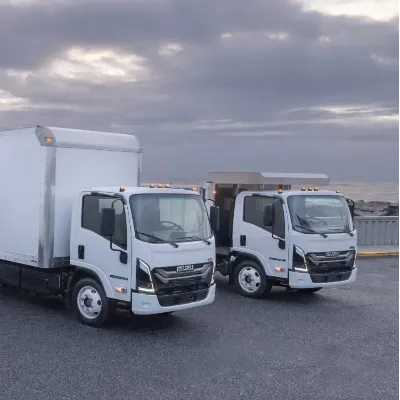
A growing number of operators—especially in trades, service work, and regional transport—are shifting focus to more versatile medium-duty and light-duty work trucks.
The reason is because they offer:
- Lower acquisition costs
- Lower fuel and maintenance expenses
- Better adaptability for mixed work
- Higher utilization in a variable-demand environment
Many business owners are discovering that a smaller, more efficient truck can do 80% of the jobs that once required a large Class-7/8 work truck—at a fraction of the cost.
Right-sizing is one of the most reliable profit-preserving strategies for 2026.
5. Delay Major Technology Shifts—But Start Preparing for Them
Electric and zero-emission commercial work trucks are still not cost-competitive for most real-world vocational or regional applications in early 2026. Infrastructure remains incomplete, and range constraints still affect many duty cycles.
But that doesn’t mean you should ignore the trend.
Smart business owners in 2026 should:
- Audit which routes or jobs could eventually be electrified
- Consider hybrid or idle-reduction technologies that offer immediate payback
- Track incentives that can drastically change EV feasibility
- Plan infrastructure slowly and strategically—not reactively
In short: don’t jump in blindly, but don’t fall behind preparing either.
6. Lean Into Data, Telematics, and Preventive Maintenance
In a margin-tight environment, the biggest wins come from operational discipline, not fleet expansion.
Telematics, driver-scorecards, and predictive work truck maintenance tools can:
- Catch expensive breakdowns before they occur
- Extend equipment life
- Increase fuel efficiency
- Improve routing and utilization
- Reduce insurance costs
In 2026, every percentage point of efficiency matters.
7. Build Flexibility Into Your 2026 Fleet Plan
The biggest risk business owners face in 2026 is inflexibility. Work volume may rise gradually—or decline again before stabilizing.
So build plans that allow you to:
- Scale up or down quickly
- Rotate underutilized units
- Sell or acquire used trucks without major financial exposure
- Adapt to seasonal fluctuations efficiently
Owners who stay agile in 2026 will outperform those who bet big too early.
Final Takeaway: 2026 Rewards Discipline, not Aggression
January 2026 is a year to operate smartly, strategically, and efficiently:
- ✔ Replace only what you must
- ✔ Optimize the trucks you already have
- ✔ Focus on profitability, not size
- ✔ Build flexibility into every decision
- ✔ Stay informed on regulations and technology—but avoid premature commitments
Business owners who follow these principles will be stronger not just in 2026, but also positioned to seize opportunities when the market truly rebounds.